AI Venture Gains Are Distorting Mega-Cap Earnings
Non-operating investment gains can widen the gap between reported net income and operating performance. A look at the distinction and the limits of an adjusted comparison.
- Topic
- Market power
- Published
- Updated
- Reading time
- 3 min read
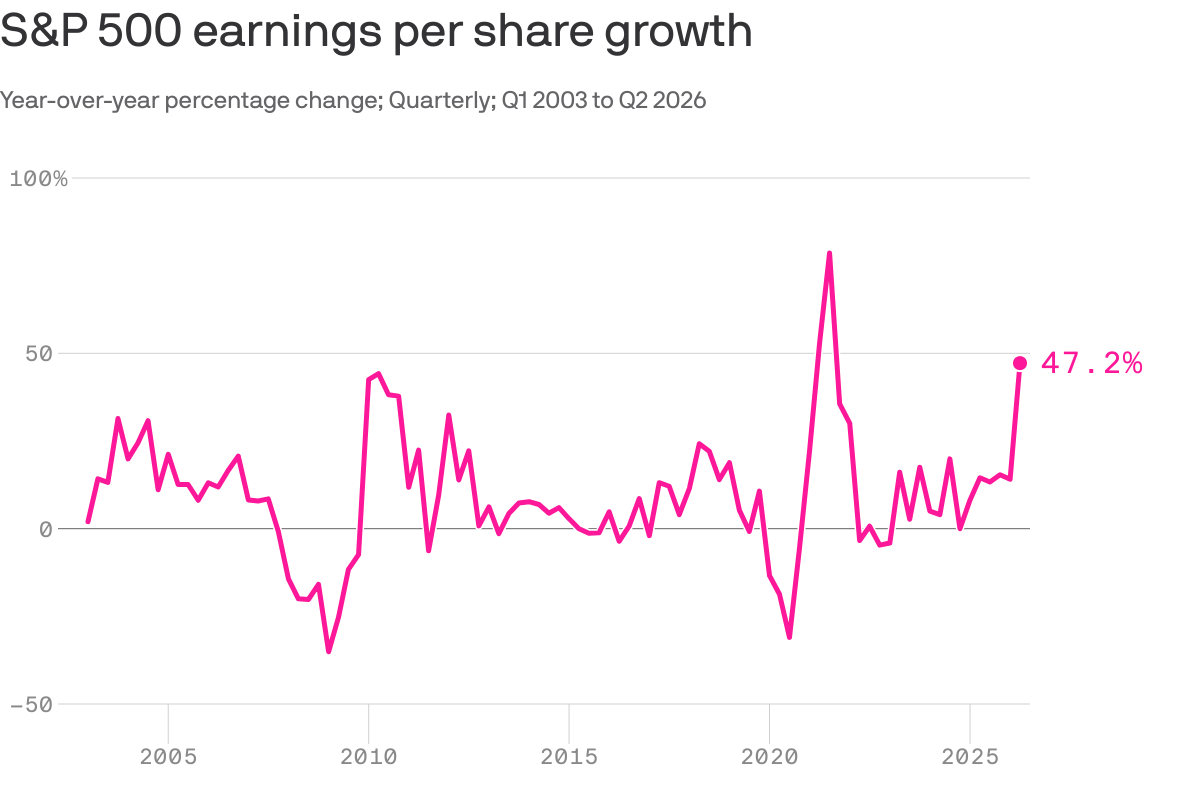
The accompanying chart shows S&P 500 year-over-year earnings-per-share growth through Q2 2026. It does not separate investment gains from other earnings. Non-operating investment gains can materially affect reported net income, but this article does not present a verified adjusted S&P 500 earnings-growth series.
The Mechanics of the Distortion
Amazon reported Q2 2026 net income of $62.6 billion, compared with $18.2 billion a year earlier. Its release identifies $53.4 billion of non-operating pre-tax other income, primarily from Anthropic investments. That supports a large investment-gain effect, but it is not an adjusted after-tax earnings-growth calculation. Accounting treatment and tax effects must be assessed for each investment.
These gains are not recurring operating income. They are accounting entries tied to the fluctuating valuations of illiquid assets, yet they flow directly into net income, where they are indistinguishable from core business performance in headline earnings reports. The result is a temporary uplift that obscures the true trajectory of revenue, margins, and cash flow.
The Anthropic IPO as Inflection Point
Anthropic announced a confidential draft S-1 submission on June 1, 2026, following its May financing announcement. These disclosures do not establish an October debut, an offering price or a first profitable quarter. A potential listing remains conditional, and its accounting effect on investors would depend on their holdings and applicable treatment.

Changes in the value of private investments can affect corporate earnings, but the timing and amount depend on the accounting treatment of each holding. This article does not establish a combined dollar total for Amazon and Alphabet or a mechanical link between an IPO price and a future write-down.
Operating Strength vs. Venture Luck
Amazon separately reported operating income of $27.5 billion in Q2 2026, versus $19.2 billion a year earlier. Operating income and net income answer different questions. An adjusted net-income comparison would require a consistent reconciliation of gains, taxes and the prior-year base; none is supplied here.
The intertwining of Big Tech and AI labs means the financial performance of the former is increasingly tied to the speculative valuations of the latter. Separating operating strength from venture portfolio volatility has become a prerequisite for any fundamentals-based assessment of these businesses.
Historical Precedent for Reversals
When Amazon and Tesla held large stakes in Rivian and Bitcoin, respectively, mark-to-market gains initially boosted earnings before reversing into impairment charges when valuations fell. The same pattern could play out with AI stakes. If Anthropic's IPO stumbles, impairment charges could wipe out a significant portion of the recent earnings uplift, leaving the underlying businesses exposed to sharper scrutiny.
The S&P 500's current earnings growth is being propped up by a handful of non-operating gains concentrated in a few mega-cap balance sheets. If those gains evaporate, the index's valuation multiples could look far less attractive. The distortion is a tailwind for now, but a fragile one — dependent on the continued ascent of a small group of private companies whose prices are still set in occasional funding rounds rather than continuous markets.
Correction — 3 October 2026: Withdrew the unverified adjusted earnings-growth percentages, percentage-point effects and combined investment-gain totals, including repetitions in the excerpt and callouts. Replaced them with separately identified Amazon reported figures, without inferring an after-tax adjustment. Removed the unsupported October IPO timetable and profitability claim. Corrected the chart description: it contains one reported EPS-growth series, not a with/without comparison. The original publication date is unchanged. Sources: Amazon Q2 2026 results, July 30; Anthropic Series H announcement; Anthropic draft S-1 announcement.
Research briefing
Get new Monopoly MOAT research by email.
New analysis and publication updates, sent when they are published.
Discussion