AI Infrastructure: The $7 Trillion Factory Floor
The physical buildout behind AI is the largest infrastructure project in history—but the economics hinge on one unproven bet.
- Topic
- Market power
- Published
- Updated
- Reading time
- 7 min read

A question typed into a phone travels hundreds of miles in seconds, arriving at a data center that consumes as much electricity as a small city. Inside, a $3 million machine liquid-cools chips running at the heat output of eighty space heaters. This is the physical reality of AI infrastructure—a buildout projected to cost $7.6 trillion by 2031, more than the inflation-adjusted cost of the U.S. interstate highway system.
Microsoft, Meta, Amazon, and Alphabet will spend roughly $725 billion on AI infrastructure this year alone, a figure that exceeds the GDP of most countries. The economics of that commitment rest on a single untested assumption: that the cost of generating each token—a unit of AI output—will fall faster than demand for tokens rises. If it doesn't, the entire supply chain could reprice in unison at the first sign of capex digestion.
The Factory Floor: Where the Money Goes
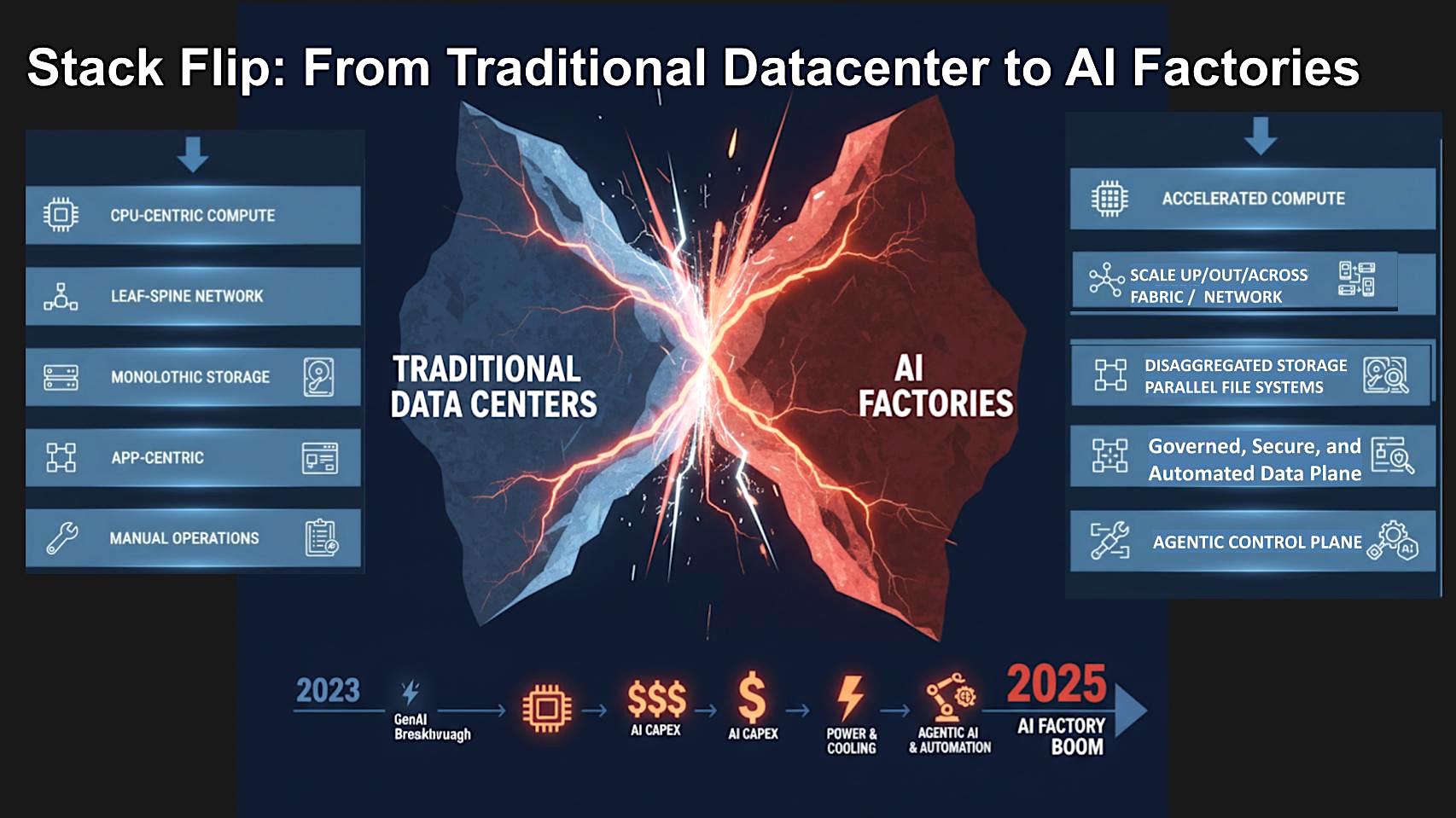
AI data centers are not server farms. They are factories. Electricity enters as raw material; tokens exit as finished goods. The production process spans six capital-intensive layers, each with its own competitive dynamics and risk profile.
Power sits at the foundation. A single AI rack draws 120 kilowatts—twelve times the density of traditional servers. At campus scale, that translates to a gigawatt, equivalent to a nuclear reactor's output. The U.S. electrical grid, designed for 1–2% annual demand growth, now faces a 4–5 year interconnection queue. Hyperscalers have responded by bypassing the queue entirely, signing 20-year deals with nuclear operators like Constellation Energy and fuel-cell providers like Bloom Energy. GE Vernova's gas turbines, sold out through 2030, serve as the stopgap.
Air cooling fails at 120 kilowatts, which is why liquid cooling has become the default. That market is projected to grow from $5.7 billion in 2026 to $29.2 billion by 2033, with Vertiv, Eaton, and Schneider Electric as the dominant suppliers. Schneider's acquisition of Motivair signals the sector's strategic weight. Power Usage Effectiveness—a measure of cooling efficiency—has become a direct financial lever: a 0.1 improvement in PUE can save $100 million annually for a gigawatt campus.
Silicon is where margin concentrates. Nvidia's GB200 rack, priced at $3 million, is the workhorse of AI inference. The company's data center revenue reached $194 billion in fiscal 2025, with 75% gross margins. AMD and Intel are distant competitors; Broadcom has carved a niche co-designing custom chips for Google, Meta, and OpenAI. The Taiwanese ODMs—Foxconn, Quanta, Wiwynn—assemble the racks but capture only 6–10% of the hardware margin.
Networking divides into two problems: NVLink for intra-rack communication and Ethernet for inter-rack. Nvidia's InfiniBand once dominated, but Ethernet now accounts for two-thirds of new deployments. Broadcom's Tomahawk chips power most high-end Ethernet switches; Arista Networks provides complementary hardware and software. The shift to open standards mirrors the broader tech industry's move from proprietary to interoperable systems.
High Bandwidth Memory is stacked vertically and bonded directly to GPUs, delivering 5–6x the bandwidth of conventional memory at 5–6x the price. SK Hynix, Samsung, and Micron control this market, with SK Hynix holding roughly 60% share. HBM is sold out through 2026, but capacity expansions already underway could trigger a price war. The memory cycle has always been volatile, and AI doesn't exempt it from that history.
Storage is the overlooked layer. Training datasets, model checkpoints, and inference logs require petabytes of capacity, and spinning disks remain the cheapest medium. Seagate and Western Digital—once dismissed as legacy players—now ship 89% of their output to cloud customers. Flash providers like Kioxia and Solidigm fill the hot-data gap, but the bulk of AI's storage demand is served by a duopoly.

The Software Moat: CUDA and the Inference Stack
Hardware is purchasable. The durable advantage lies in software. Nvidia's CUDA platform, a 20-year investment, functions as the operating system of AI. Every major framework—PyTorch, TensorFlow, JAX—optimizes for CUDA first. Switching to AMD's ROCm or Intel's oneAPI requires retraining engineering teams and rewriting production code, a prohibitive cost for organizations running $100 million training jobs. CUDA's grip on the developer ecosystem is the structural explanation for why Nvidia's gross margins exceed Apple's.
Below the model layer, serving engines like vLLM and Nvidia's TensorRT reduce inference costs by 3–10x through batching, caching, and quantization. These tools are why OpenAI and Anthropic can cut API prices by 80% in a year without new hardware. The token manufacturing cost curve is collapsing—but only for those who already control the software stack.
The $7 Trillion Bet
The AI infrastructure buildout is a closed loop. Hyperscalers spend $725 billion annually on capex, much of it financed through corporate bond issuance. Nvidia reinvests a portion of its profits into AI labs like OpenAI and CoreWeave, which then purchase Nvidia chips. Those labs sign compute deals with hyperscalers, often using capital those same hyperscalers provided. The only fresh money entering the system comes from end users—consumers paying $20 per month for subscriptions and enterprises adopting APIs.
The math at the foundation is precarious. OpenAI and Anthropic's combined annualized revenue run rate exceeds $70 billion, but actual 2026 revenue will be a fraction of that figure. OpenAI is projected to lose $14 billion this year even as it spends billions on inference. The $7.6 trillion buildout hinges on token production costs falling faster than token demand rises. If that relationship inverts, the capex digestion cycle could be severe.
The risk is asymmetric. A 10% capex cut from a single hyperscaler would reprice the entire supply chain—from memory to cooling to power. The grid interconnection queue, already 4–5 years long, could become a graveyard for stranded assets. Political pressure is growing in parallel: data centers in the PJM grid region have added $9 billion to capacity auctions, translating to $16–18 per month increases in residential electricity bills.
Who Captures the Value—and Who Absorbs the Risk
Profit pools are concentrated at the top of the stack. Nvidia's 75% gross margins on data center revenue are the clearest example, but Broadcom's 73% gross margins on custom silicon and SK Hynix's HBM pricing power tell the same story. Companies that control scarce resources—CUDA, HBM, gas turbines—extract the majority of the economics. Those in commoditized layers do not. Taiwanese ODMs assembling racks capture 6–10% margins; the hyperscalers themselves face pressure to demonstrate returns on infrastructure spend that may not be profitable at scale.
Meta's Reality Labs division lost $20 billion in 2025, and Alphabet's cloud growth is increasingly tied to AI workloads whose unit economics remain unresolved. The losers in this cycle are the companies caught without pricing power, without proprietary software, and without the balance sheets to survive a capex winter.
Depreciation is the most underpriced risk in the cycle. AI chips are typically written off over 4–6 years, but a five-year-old GPU competes against chips that are 10x more efficient. If depreciation schedules compress, reported profits across the industry could deteriorate faster than revenue models anticipate. The hyperscalers are already moving capex off-balance-sheet through neoclouds like CoreWeave—an arrangement that transfers cost visibility away from the companies doing the spending.
When the Cycle Turns
The companies with durable positions in this cycle share a common attribute: they control something that cannot be quickly replicated. Nvidia controls the software ecosystem that ships with its hardware. SK Hynix controls HBM capacity that competitors cannot match on short timelines. The hyperscalers control the cloud relationships through which most AI workloads will eventually be monetized. These are genuine structural advantages—but they are only as durable as the demand that justifies the capital behind them.
A capex winter triggered by slowing enterprise adoption or a hyperscaler earnings revision would not arrive gradually. The supply chain is tightly coupled: a guidance cut from one major customer propagates through silicon orders, memory contracts, cooling hardware, and power agreements simultaneously. The grid will eventually adapt and the chips will keep improving, but the financial architecture of the buildout—circular capital flows, off-balance-sheet structures, and depreciation schedules that lag technology cycles—means the adjustment, if it comes, will be faster and sharper than the construction was.
Research briefing
Get new Monopoly MOAT research by email.
New analysis and publication updates, sent when they are published.
Discussion