The Real AI Gold Rush Isn’t Nvidia—It’s the Shovels
Why the smart money is betting on the nine choke points powering the AI build-out—and why the Mag 7’s dominance is a ticking time bomb.
- Topic
- Market power
- Published
- Updated
- Reading time
- 4 min read
The Strait of Hormuz just slammed shut, and the AI supply chain is sweating—not because of Nvidia delays, but because the real bottlenecks (the ones no one talks about) just became far more valuable.
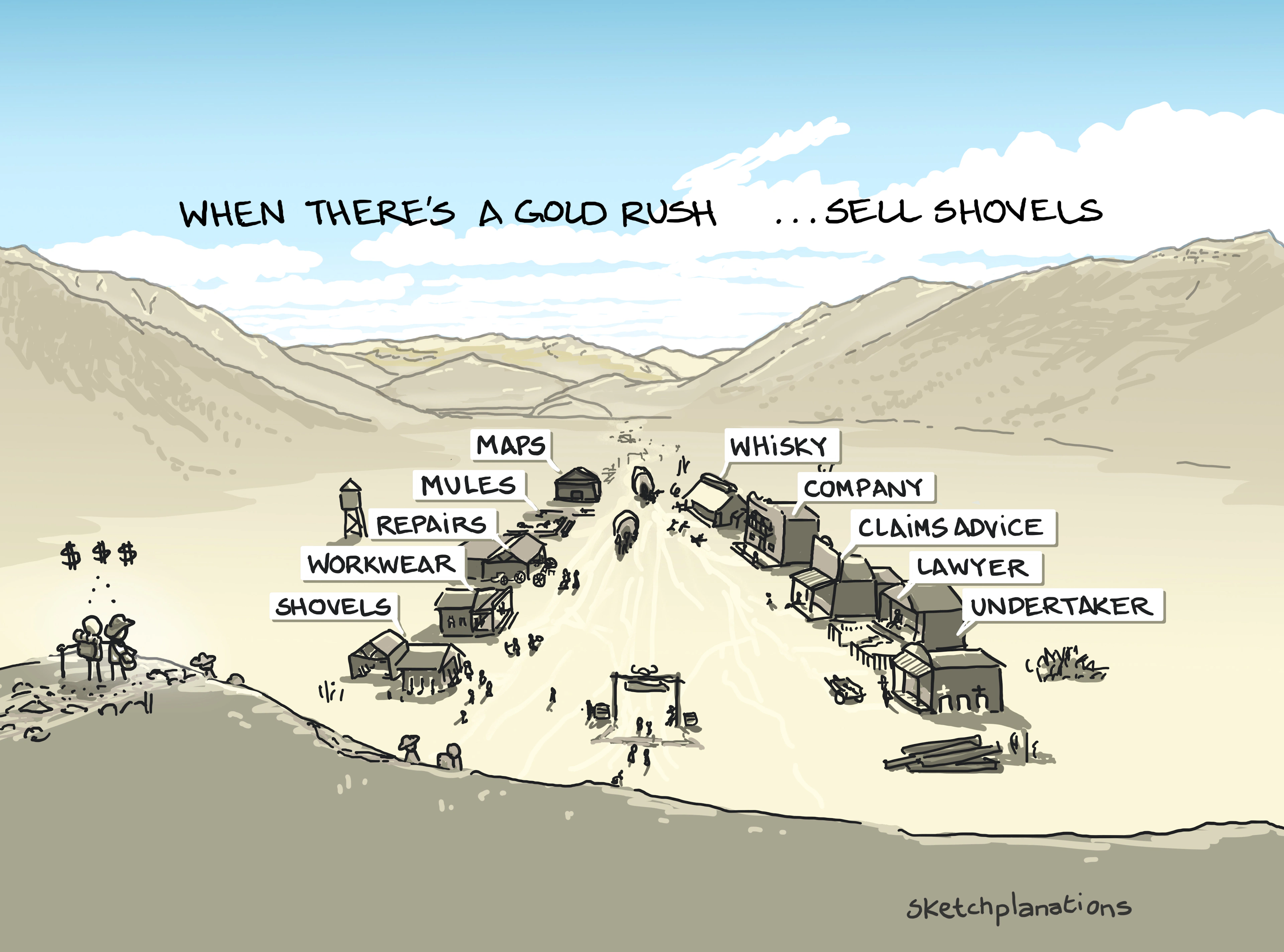
In every gold rush, the winners sell shovels. The AI boom is no different. While everyone fixates on Nvidia, a handful of companies control the nine physical constraints making the build-out possible. They’re the only game in town.
The Mag 7’s Fragility Is Your Opportunity
The S&P 500 is down 2% YTD, while international stocks (MSCI ACWI ex-USA) are up 32% in 2025. Three reasons this rotation isn’t a fluke:
1. The dollar is weakening fast, making international assets more attractive. (See: 2002-2007, when a 40% dollar drop led to 80% outperformance.) 2. European fiscal stimulus is kicking in, with €750B flowing into infrastructure and AI data centers. 3. The Mag 7’s 35% S&P weight is a time bomb. Their 30x P/E ratios are priced for perfection—any slowdown will hit hard.
The Nine AI Choke Points No One’s Talking About
These aren’t chipmakers. They’re the companies controlling the physical constraints that make AI possible. And they’re printing money.
1. Nuclear Power: Vistra’s 3.8 GW Monopoly
AI data centers need 132 kW per rack—10x traditional servers. With natural gas prices spiking, Vistra (VST) is the only player with 3.8 GW of contracted nuclear power. Meta and Amazon locked in 20-year deals at market rates. Margins expand as energy prices rise.
2. The Grid’s Gatekeeper: Eaton’s 11-Year Backlog
Transformer lead times are 3 years. Half of 2026’s data center builds are delayed or canceled. Eaton (ETN) owns the entire chain—transformers, switchgear, power distribution. Orders up 200% in one quarter. Backlog: 11 years’ worth of demand.
3. Liquid Cooling: Vertiv’s $15B Backlog
Air cooling can’t handle 132 kW racks. Liquid cooling is the only answer. Vertiv (VRT) is Nvidia’s preferred infrastructure provider. Earnings per share grew 199% last year. Revenue guided up 30% in 2026.
The Silicon Stack: Where the Real Upside Lives
4. Memory: Micron’s HBM Dominance
High-bandwidth memory (HBM) is stacked on every Nvidia AI chip. Only three companies make it: SK Hynix (62%), Samsung (17%), and Micron (21%). All are sold out through 2026. Micron’s U.S. supply chain is a massive edge as Korea’s fabs face helium shortages.
5. Packaging: Amkor’s CoWoS Goldmine
CoWoS (Chip-on-Wafer-on-Substrate) demand is growing at 80% a year. Supply? Only 50%. Amkor (AMKR) is the only second source for Nvidia’s overflow. Their Arizona facility (next to TSMC’s U.S. fabs) is expected to triple revenue this year.
6. Networking: Broadcom’s $73B Backlog
Broadcom (AVGO) entered 2026 with $73B in signed AI orders—18-24 months of committed revenue. They control 60-70% of custom AI chips (Google TPU, Meta MTIA) and 80% of Ethernet switching (Tomahawk 6 chip). AI revenue hit $8B last quarter.
The Physical Layer: Supply Deficits = Pricing Power
7. Copper: Southern Copper’s 52% Margins
AI data centers need 27-33 tons of copper per MW. The 2026 supply deficit? 330,000 tons. Southern Copper (SCCO) has the largest reserve base (51.1M tons) and the lowest production cost (42 cents/lb). Revenue nearly doubled in 5 years. Margins: 52%.
8. Fiber: Corning’s 60-Week Lead Times
AI data centers need 36x more fiber than traditional racks. Lead times? 60+ weeks. Corning (GLW) makes all of it. Meta signed a $6B multi-year deal. Demand grows at 22-25% annually, but supply can only expand at 11-19%.

How to Play This (Without Betting the Farm)
You don’t need all nine stocks. Here’s the framework:
1. Foundation (40%): Power/cooling (Vistra, Eaton, Vertiv). Steady demand, no chipmaker risk. 2. Silicon Stack (40%): Memory/packaging/networking (Micron, Amkor, Broadcom). Highest upside. 3. Physical Layer (20%): Copper/fiber (Southern Copper, Corning). Supply deficits = pricing power.
The bottom line? The AI boom isn’t about chips. It’s about power, cooling, memory, packaging, networking, copper, and fiber. These companies have real pricing power—while the Mag 7’s dominance looks increasingly fragile.
The real money in AI isn’t in the obvious plays. It’s in the companies sitting on the physical constraints the build-out can’t move without.
Research briefing
Get new Monopoly MOAT research by email.
New analysis and publication updates, sent when they are published.
Discussion