SpaceX Won’t Save Your Portfolio—But These Hedges Might
SpaceX is a single-stock exposure, not a portfolio hedge. Here is what 2022 revealed about stock-bond diversification—and how to assess bonds, real assets, and alternative strategies without assuming that any asset always protects.
- Topic
- Market power
- Published
- Updated
- Reading time
- 3 min read

SpaceX completed its IPO on June 12, 2026 and now trades on Nasdaq under SPCX. The cited Patrick Boyle video examines the company’s filing, valuation, governance and operating assumptions; it does not present a portfolio-hedging strategy. The connection here is ours: however attractive a company may appear, one stock is concentrated equity exposure—not a hedge.
Portfolio protection begins by naming the risk. A growth shock, inflation shock, interest-rate shock and short-term liquidity need can require different defenses. No asset is guaranteed to rise whenever stocks fall.
When the Bond Hedge Can Fail
High-quality bonds remain useful, but their diversifying behavior is regime-dependent. In 2022, the S&P 500 returned -18.1% and the Bloomberg U.S. Aggregate Bond Index returned -13.0%. Both fell, but bonds did not amplify the loss relative to an all-equity portfolio: LPL calculates that a hypothetical 60/40 portfolio lost about 16%.
The description of 2022–2023 as one continuous period in which stocks and bonds “bled” is also inaccurate. In 2023, the S&P 500 produced a 26.29% total return and the Aggregate returned 5.53%.
BND is a broad U.S. investment-grade bond ETF. Vanguard reported an average duration of 5.7 years as of July 31, 2026, meaning its price remained sensitive to interest-rate changes. Duration does not measure sensitivity to an equity drawdown, and it does not make a bond fund “just as volatile” as equities.
In a February 2026 Reuters commentary, Fidelity International portfolio manager Taosha Wang argued that high-grade bonds can lose hedging power during inflationary, fiscal or liquidity shocks. Her conclusion was not that bonds are obsolete, but that investors should identify the particular risk they intend to hedge and avoid assuming correlations are stable.
A hedge should be selected for a defined risk—not because it worked during the last shock.
Diversification by Job, Not Fashion
Gold, commodities and systematic strategies can add return drivers that differ from stocks and bonds, but none is a universal hedge. Gold can be volatile, commodities are cyclical, and alternative strategies can introduce high fees, leverage, derivatives, liquidity, model and manager risks.
Gold was roughly flat in U.S. dollars in 2022 and rose about 15% in 2023. That history illustrates regime dependence; it does not guarantee protection in every drawdown.
GOLY’s prospectus describes a combination of investment-grade bonds, gold-futures exposure and commodity derivatives. It seeks income and long-term capital appreciation; it does not promise inflation protection, and its futures and swaps introduce additional risks.
ATRFX’s prospectus identifies Catalyst Capital Advisors—not BNP Paribas—as its investment adviser. The fund seeks long-term capital appreciation partly through exposure linked to a BNP Paribas systematic index. Low correlation is an objective, not a guarantee.
BNP Paribas’s 2026 allocator survey reported interest in quant-equity, quant multi-strategy and discretionary-macro funds. Morgan Stanley similarly describes market-neutral approaches as potentially useful diversifiers. Neither establishes a universally superior hedge.
Claims about how often a strategy succeeds during equity drawdowns need a defined index, sample period and calculation. Without those inputs, headline hit rates should not drive allocation decisions.
SpaceX Is a Stock, Not a Hedge
SEC filings show that SpaceX completed its IPO and began trading on June 12, 2026. Its shares may be relevant to an investor’s growth allocation, but one company cannot diversify company-specific risk by itself.
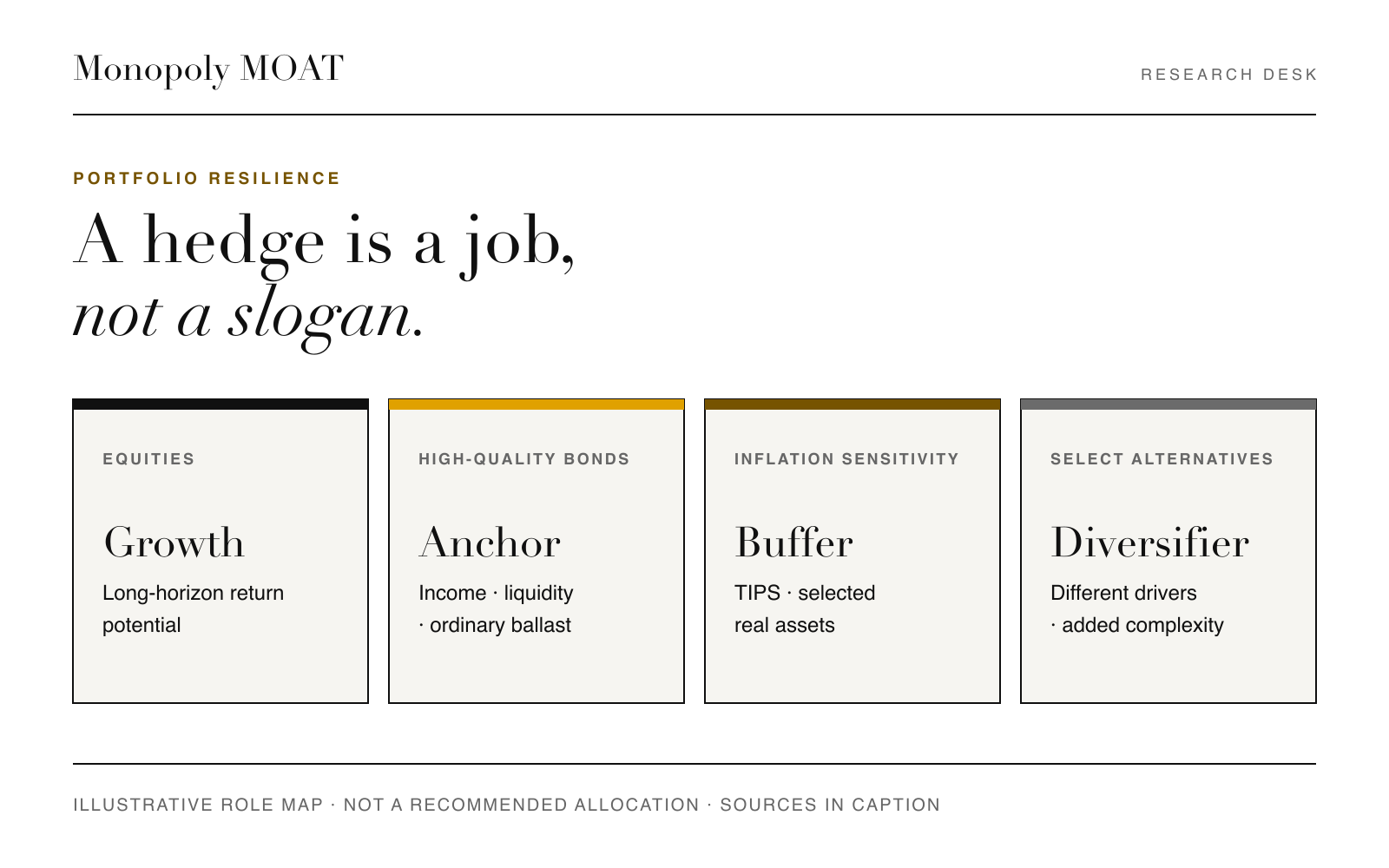
SEC Investor.gov guidance emphasizes spreading exposure across and within asset classes. A resilient portfolio may combine equities for growth, high-quality bonds for income and liquidity, inflation-sensitive assets for particular price shocks, and carefully selected alternatives for additional return drivers. Every sleeve can fail in some environments.
The Bottom Line
The 60/40 portfolio is not universally defensive, and 2022 showed that stocks and bonds can fall together. That supports more deliberate, regime-aware diversification—not the categorical claim that bonds are obsolete or that alternatives always work.
SpaceX should be evaluated as a stock, not as portfolio protection. The relevant question is not which asset is “the future,” but which combination fits the investor’s risks, time horizon, liquidity needs, costs and tolerance for loss.
Research briefing
Get new Monopoly MOAT research by email.
New analysis and publication updates, sent when they are published.
Discussion