Anthropic's IPO: The AI Lab Oligopoly's Stress Test
A $965B private valuation hinges on whether enterprise pricing power can outrun unsustainable inference costs.
- Topic
- Market power
- Published
- Updated
- Reading time
- 4 min read
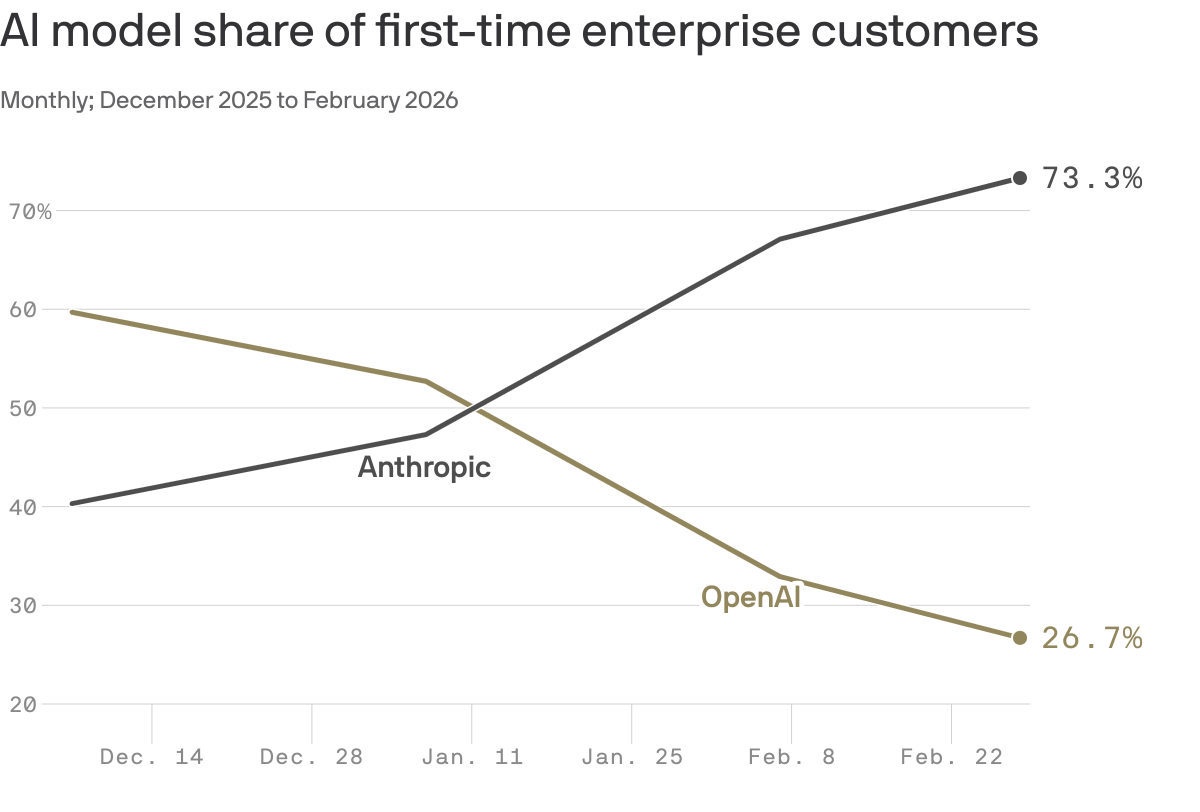
Anthropic announced on June 1, 2026, that it had confidentially submitted a draft registration statement to the SEC, four days after announcing a $65 billion Series H at a $965 billion post-money valuation. Anthropic reported run-rate revenue above $47 billion in May. The cited announcements do not establish an enterprise-revenue percentage, a first profitable quarter or an IPO date. A successful IPO re-rates the entire private AI complex and marks up the stakes held by Amazon and Alphabet. A failed one confirms the suspicion that AI labs are burning capital without a path to sustainable margins.
Revenue Concentration in the AI Lab Oligopoly
The cited announcements do not provide a customer-revenue concentration table. Infrastructure suppliers and investors should not be treated as a measured breakdown of Anthropic’s customers. Revenue concentration and the economics of those relationships remain questions for fuller financial disclosures.
The pricing model compounds the risk. Enterprise contracts are increasingly structured on a per-million-token basis, tying revenue directly to inference costs. When OpenAI and Anthropic shifted to this model, customers like Uber exhausted their annual token budgets in a single quarter, triggering widespread complaints. The problem is structural: inference costs do not scale linearly with usage, and large language models lack consistent return on investment for enterprise users. If customers revolt against token pricing, revenue growth could reverse just as quickly as it accelerated.
The Inference Cost Paradox
AI labs justify their valuations with the claim that inference—running trained models to generate outputs—will eventually become profitable. The evidence is thin. Dario Amodei's assertion that inference is already profitable remains a stylized fact, not a demonstrated reality. Enterprise adoption patterns point the other way: customers are willing to experiment with LLMs but unwilling to pay prices that cover the labs' capital costs. When Uber's token usage spiked, it was not because the company discovered new value in AI; it was because the cost structure was unsustainable for the customer.
The labs have relied on hyperscalers to absorb the shortfall. Microsoft's $261 billion in capex since 2022 has yielded only single-digit billions in AI-driven revenue, most of which flows back to OpenAI. Amazon and Alphabet are making comparable bets on Anthropic, treating their stakes as strategic options rather than standalone businesses. This circular dynamic—cloud providers fund the labs, which then spend on cloud services—creates the appearance of demand. The IPO will test whether public markets are willing to underwrite that cycle.

How Amazon and Alphabet Absorb the Outcome
Anthropic's $965 billion valuation is not solely a bet on its own business. It is a leveraged bet on Amazon and Alphabet, which hold material stakes in the company. A strong debut marks up those positions, boosting the equity value of both hyperscalers. A soft one forces writedowns, pressuring balance sheets already stretched by AI capex. The Nasdaq-100's heavy weighting in these two names means the IPO outcome will ripple through passive vehicles that track the index.
The dependency runs both ways. Anthropic's enterprise contracts function as loss-leader arrangements for the hyperscalers, designed to lock in cloud spend. If the IPO falters, the labs will likely renegotiate terms at lower prices, forcing Amazon and Alphabet to choose between subsidizing the labs' losses or accepting slower growth in their cloud segments.
Open Source and the Closed-Model Moat
Anthropic's moat argument rests on the claim that closed-source models outperform open-source alternatives. Open-source models have closed the performance gap on many benchmarks, often at a fraction of the cost. Chinese labs, operating under GPU export restrictions, have demonstrated that distillation techniques can produce competitive models without equivalent capital intensity. If open-source adoption accelerates, it directly undercuts the pricing power of closed-source labs like Anthropic and OpenAI.
Framing open source as a national security risk is a defensive tactic, not a durable competitive advantage. AI competition is a contest between business models, not nations. If open-source alternatives can deliver 80% of the performance at 20% of the cost, enterprise customers will switch, and Anthropic's S-1 will need to explain why they won't.

The AI lab sector is consolidating into an oligopoly, but barriers to entry are lower than the valuations imply. Whether enterprise demand translates into durable pricing power—or simply reflects the circular capex cycle that hyperscalers have funded so far—is what Anthropic's public debut will actually resolve.
Correction (Aug. 25, 2026): An earlier version gave 2025 as the year of Anthropic’s confidential draft registration statement. Anthropic announced the submission on June 1, 2026; its Series H announcement was May 28, 2026.
Primary sources: Anthropic’s confidential draft registration statement announcement; Anthropic’s Series H announcement.
Correction — 3 October 2026: Withdrew the unsupported enterprise-revenue percentage, customer-concentration assertions and first-profitable-quarter claim. The cited financing and confidential-filing announcements do not establish those facts or an IPO date. Corrected the body image description to identify customer share, not revenue or token-budget exhaustion. The earlier date correction remains visible; the original publication date is unchanged. Sources: Anthropic Series H announcement; Anthropic draft S-1 announcement.
Research briefing
Get new Monopoly MOAT research by email.
New analysis and publication updates, sent when they are published.
Discussion